


Complex product
Modernizing Mission-Critical Infrastructure
Workflow-heavy systems in defense environments carry operational consequence for the network engineers and security admins who depend on them daily. This platform supports globally deployed networks where compliance, visibility, and execution accuracy are non-negotiable. The modernization effort focused on transforming legacy manual tooling into a cohesive, orchestration-ready system designed for control, extensibility, and long-term automation readiness.
At a glance
Role
Product Design Director
Level
Director
Scope
Platform/Product Design, Design Systems, and AI-assisted Workflows
Category
Complex product
Outcome
40+ engineering org aligned · 3 designers led (9-person cross-functional team) · 10k+ certificate workflows modernized · Automation-ready platform (beta)
Overview
As the Product Design Director, I led product strategy and UX architecture for a security-first platform built for network engineers and security admins managing certificate and monitoring workflows across globally deployed networks. We transformed a legacy, manual system into a cohesive, orchestration-ready foundation built for compliance, control, and automation. Working alongside Product and Engineering leadership, I helped shape the platform vision, established system-level UX patterns, and partnered on roadmap prioritization. The work restructured certificate and network monitoring workflows into logic-driven, role-aware systems, foundational for automation and AI readiness.
Certificate Authority Management
Scalable tooling to manage 10k+ certificates with smart filtering, bulk actions, and expiration handling.
Deployment Configuration Workflows
Logic-first orchestration for semi-automated workflows across internal deployment scenarios.
Design Systems & Strategy
Scalable, accessible frameworks across motion, content, and UI, tailored to workflow management and security needs.
Coming Soon 🔒
Predictive UX & Automation Readiness
Automation triggers, smart defaults, and MVP AI chatbot exploration to support ops users in complex environments.
Currently in Development 🔒
Certificate Authority Management
In a security-first platform used across field-deployed networks, I led the product strategy and UX direction for certificate authority tooling—critical infrastructure for encrypted comms and compliance visibility. My role was to shape how operational teams across security and IT could confidently take bulk actions across 10k+ certs without breaking flow or compliance.
As the product design lead, I worked cross-functionally to translate policy-heavy, technically dense workflows into role-aware tools that surfaced the right certs, supported revocations, and prepared the system for future AI/automation integrations. I guided strategy, shepherded design execution, and partnered with engineering on the architecture of filters, alerts, and modular views.
Workflow goals
Provide pre-filtered views to support continuous monitoring (e.g., ‘certs expiring soon,’ certs needing attention)
Enable custom filters and logic to query cert subsets by status, expiration, or key state
Support bulk actions: revocations, re-issues, exports.
Design for proactive alerting and automatic-readiness.
Key UX challenges
Users didn’t need to see 10k+ certs at-a-glance, they needed relevant, actionable subsets.
Legacy UI lacked contextual search and grouped logic.
Revocation was manual and one-at-a-time—risky and slow in urgent cases.
Context Loss: Lack of surface-level insight required deep record-drilling.
Leadership solutions
Defined smart views (“Since Last Look”, “Expiring Soon”) to support operational triage
Led UX for simple + advanced filtering across expiration, status, and role logic
Architected alert-ready query builder for proactive workflows
Standardized role-based flows for safe, scalable revocation at scale
Embedded context-aware UI to improve certificate authority and decision velocity

Deployment Configuration Workflows
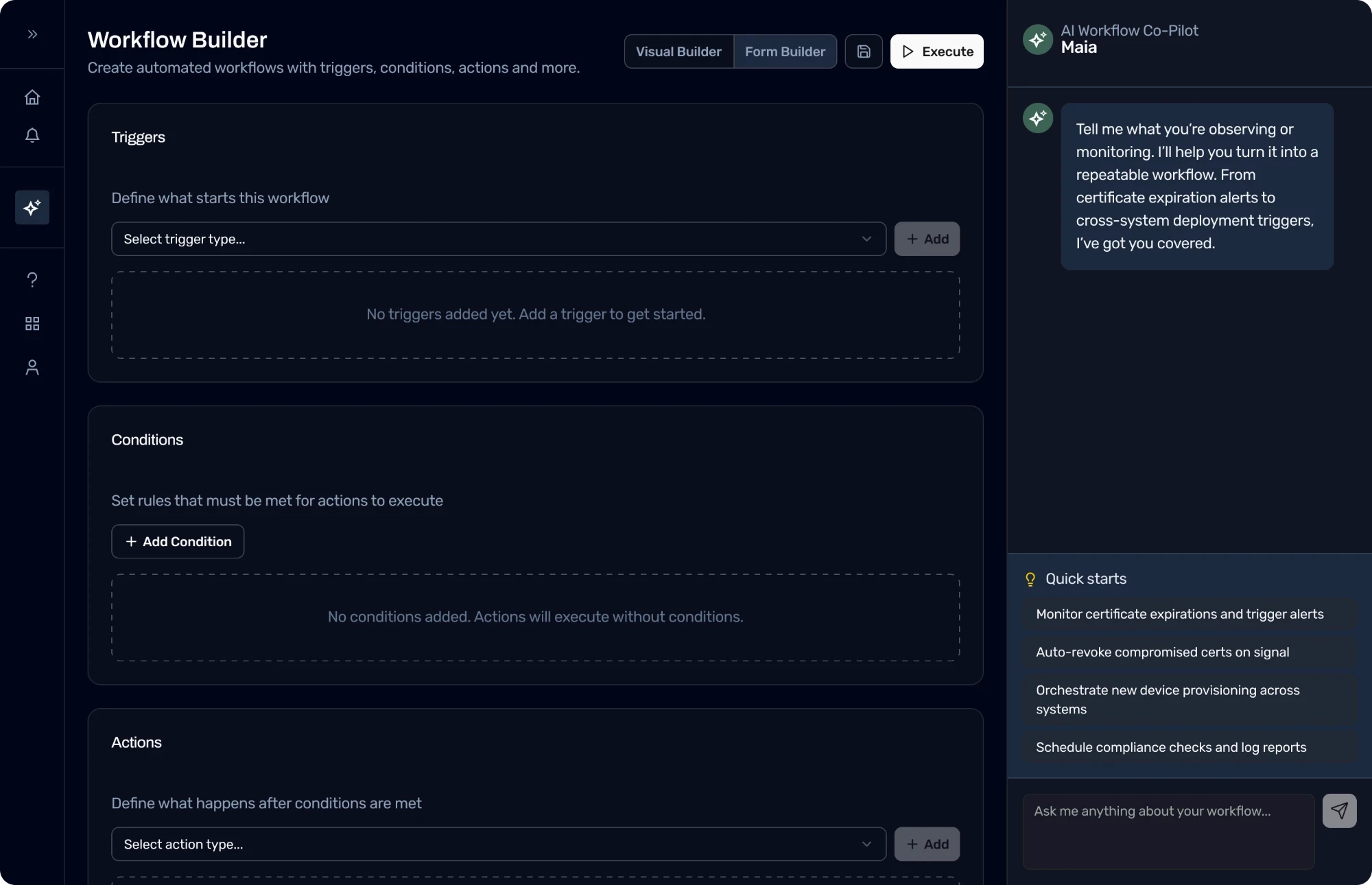
I led the UX and systems design for a logic-based workflow engine supporting custom deployments across secure environments. This flexible orchestration layer lets admins compose, gate, and sequence operations using GraphQL-based actions, external triggers, and smart input/output mapping.
The design challenge was twofold: simplify authoring for operational users while preserving the flexibility and extensibility of the underlying logic model. I worked across product and engineering to define the execution model, user roles, and UX scaffolding—enabling future support for branching, looping, and automation triggers.
Key capabilities
Admins can define multi-step flows using actions exposed by component adapters (queries, mutations, or custom APIs)
Workflows supported automatic execution, manual triggers, and ‘pause-and-wait’ gating based on external events or alerts
Outputs from one action could be mapped as inputs to another, enabling complex dependencies without burdening the user
Leadership focus
Shaped UX architecture for the workflow builder and execution model
Defined how inputs/outputs, instance IDs, and mapping logic surfaced in the UI
Designed for extensibility: future-proofing interfaces to support branching, looping and system-driven alerts